| (insert your NIE or newspaper logo here) |
Weekly Online LessonOnline Lesson ArchiveGrade Level: 6-12
|
STS-107: A Turning Point in the Space Shuttle Program
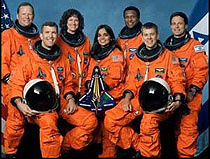 On February 1, 2003, Saturday morning cartoons were replaced by images of tragedy soon after NASA lost contact with the Space Shuttle Columbia crew as they approached Florida's Kennedy Space Center. Eyewitness accounts from people living along the shuttle's flight path -- from Southern California through Louisiana -- reported comet-looking streaks, sonic booms and pieces of debris. In a broadcast later that afternoon, President George W. Bush confirmed the nation's suspicions: "The Columbia is lost," he said solemnly.
Seven crewmembers lost their lives, while a nation mobilized to find out why. Since the event, more than 12,000 pieces of shuttle wreckage have been collected, as NASA, federal and state authorities -- with the critical helping hands of local residents -- continue to comb the debris path to recover all of the clues.
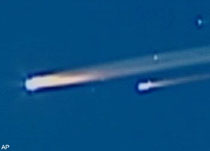 Shuttle flight into space began in 1981 with the success of Columbia's first mission. Unfortunately, it was also the first shuttle to fail during re-entry, costing the lives of its crew. The mission's tragedy has people pointing fingers at a number of underlying causes, such as the program's diminishing budget over the years, understaffing, outdated technology, and the shifting of political power and priorities from one Presidential term to another.
NASA created the space fleet's four shuttles (also called "orbiters") -- the Columbia, the Challenger, the Discovery, and the Atlantis -- to be used repeatedly. However, with the 2003 and 1986 fatal disasters and the apparent decline of enthusiasm for space exploration, the shuttle program is under close scrutiny for flaws and fixes. Ultimately, the findings, along with political and public sentiment, will re-shape the shuttle program and possibly re-direct its future.
So for this week's lesson, you'll learn more about the Columbia crew and their mission, how space shuttles work, and you'll also explore the history of the shuttle program.
Columbia's Last Mission
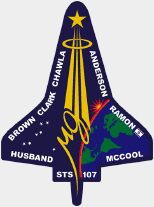 Begin exploring the STS-107 mission and its crew at Space.com's Space Shuttle Columbia Special Report site. In the Multimedia section, click on Shuttle Columbia's Long Road to Space. Using the Image Viewer, browse through the mission's interactive timeline.
Also within that section, click to read the Crew Biographies. Take some time to read about the seven astronauts: Rick Husband, William McCool, Kalpana Chawla, David Brown, Mike Anderson, Laurel Clark, and Ilan Ramon. If you have a QuickTime player or Windows MediaPlayer, you can also click on each SPACE TV Interview to watch videos of the crewmembers. Where was each astronaut born and how did they grow up? What kind of schooling, training or other experience did each of them have? What were his or her specialized duties during the mission?
Next, visit NASA's STS-107 Virtual Astronaut site to learn about some of the shuttle crew's 80-plus experiments. If you can open PDFs with Acrobat Reader, explore the Payload and Experiments section. You can read about some of the mission's objectives in detail, many of which will help scientists understand how our bodies function and react to different environments. For example, by monitoring our astronauts in space, scientists can discover better ways to treat human illnesses on Earth, like Overcoming Osteoporosis and preventing Kidney Stones. Pick a few experiments that interest you. How exactly are they using scientific principles in each experiment? What are the Earth Benefits and Applications of each?
Before leaving the Virtual Astronaut site, play around with some of the cool Student Activities, such as Heart in Space and Muscle in on Muscles.
The Space Shuttle Program
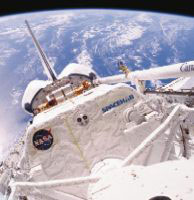 So now that you know what the Columbia crew was doing up there, find out how they got there. Start off at Space.com's Space Shuttle Interactive Tour. Click on the tabs above the shuttle image to get an overview of the Orbiter, External Tank, and Solid Rocket Boosters and how they've been improved over the years. Why do you think each of those upgrades was made?
Learn more about the shuttle program at the Space Transportation System section at NASA's Human Spaceflight site. Here, you can read the overview of the Space Shuttle Program and Space Shuttle Requirements, or check out the Launch Sites and Mission Profile.
The Shuttle Reference Manual is another great resource here. Click on any of the shuttle components, like External Tank and the Orbiter Crew Escape Systems, for more detail about how they're built and used.
Then explore Behind the Scenes to find out how the Planning, Training, Engineering, Processing and Research teams do their jobs and work together to make the program fly. What are some of the Facilities and Projects noted for each department? Don't forget to Meet the People involved here, as well. How do they each contribute their knowledge and experience to the program?
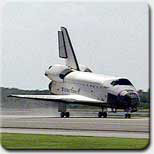 Your last stop is at the Space Shuttle Program home page, where you can start a tour back in time and learn about all of the shuttle missions since they began in 1981. At the top left of the page, you'll find the Shuttle Archives, where you can click back to previous missions or click forward to mission scheduled in the future.
On each mission page, you can read about The Crew, the Cargo, the Timeline and the EVA, or Extravehicular Activities. Compare and contrast different missions. How was each mission's goals different? How was the cargo and equipment astronauts used different from other missions? What implications did the space studies have for humans living on Earth? What about for living off of Earth?
Do you think space exploration, especially the Space Shuttle Program, is a worthwhile endeavor for our nation? Why or why not?
Newspaper Activities
Follow the Columbia investigation, or other Space Shuttle news, in Targetnewspaper. Have NASA and other experts discovered any new information about the disaster? What do they know and what remains a mystery? How is their understanding of the tragedy helping scientists and engineers improve this space flight program? Meanwhile, what how are politicians and the public reacting? How is this complex investigation impacting the scheduled shuttle mission for Atlantis? What about the future of the space shuttle program overall?

© Copyright 2002
Learners Online, Inc.